What Medieval Europe Did With Its Teenagers

http://www.bbc.com/news/magazine-26289459

This article, “What Medieval Europe Did With Its Teenagers” was posted on BBC news by William Kremer. It basically summarizes the apprenticeship system that was in place following the Black Plague in Europe in 1300– due to the disease that wiped out more than half of the working population, teenagers (and sometimes children as young as seven) provided cheap labor. Additionally, parents could send their children off and save money by taking in other children and feed them less.

What I personally found interesting about this article is the relatable qualities the medieval teenagers have to modern day teenagers. Boys had trouble policing their own sexuality, and many had contracts that would double the amount of time spent in apprenticeship if they were found participating in sexual behavior. Additionally, children in France, Germany, and Switzerland who disbanded their apprenticeships would form gangs known as the “abbeys of misrule” and rebel.

Overall, this article made medieval times incredibly interesting and relatable and I would recommend it– a great read!
“Richard III Excavation: Body Found at Site was a Woman”

A coffin found near the burial site of Richard III was opened this morning, revealing a second coffin within the coffin. The coffin was made out of lead, and found in a prominent spot in the yard, usually reserved for important individuals, which led archaeologists to believe that it contained an important knight or friar. They were surprised to find that the careful burial contained the body of an elderly woman, and there is speculation that she may have been an important donor, or possibly the founder of the church.

http://www.bbc.com/news/uk-england-leicestershire-31644903


Religious artwork during medieval times

Reading through The New York Times yesterday, I came across one of my favorite sections other than the book review: the antiques critique. I do not know how that title cannot make anyone smile. So I searched through the archive and found an article by Eve M. Khan, “Not All Medieval Sacred Art was Anti-Semitic.” Though Khan divides the article into three sections that are only loosely cohesive because the controlling idea of post cards and religion keep the article together, it was an interesting read because of the story it tells.

In Medieval art, “Jewish men, and a few women were depicted either as kindly Old Testament elders or hawk-nosed, greedy, murderous demons.” Immediately, I looked this art up on Google Images and indeed, found examples of Anti-Semitic art; however, the article’s next claim made me think that people living during Medieval times were also accepting of religious differences. Khan assents and raises another point, “the more tolerant artworks have remained largely unexplored.” This raises the question of whether or not society hyper focuses on bad press and thus, crafts bad attitudes about time periods because they ignore other styles of artwork. If art historians focus their attention on the attitude that all artwork created during Medieval times was Anti-Semitic, their research and commentaries will also likely hold these beliefs.

Khan traces Professor Lipton, writing a new book, in her travels across Europe to debunk the myth that all Medieval art was anti-Semitic. Lipton argues that the paintings were not supposed to arouse hatred, they were meant to, “draw worshipers’ attention” to the mass. She further explains through the perspective of the church, “We want you to look but not understand. We want you to ask us what’s going on.”

The article leaves me to investigate the question of religion during medieval times, but as I learned while preparing a paper for a class, this is no simple task.

nytimes.com/2014/10/31/arts/design/not-all-medieval-sacred-art-was-anti-semitic-.html?_r=0

Medieval Manuscript Found in UVA Library

UVA Manuscript

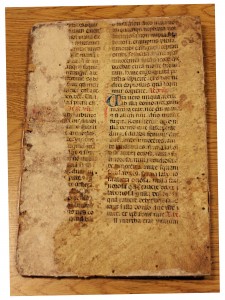
Two pages from a medieval European manuscript were discovered among the rare books at the University of Virginia’s Claude Moore Health Sciences Library. They were found when the boards detached from a book’s binding (c. 1550), and library staff believes that the manuscripts were used as binding material. It is so counterintuitive to see a manuscript used as scrap material! The discovery is an interesting reminder of the changing values surrounding the materiality of books during the early years of printing.

http://news.hsl.virginia.edu/?p=6443

Medieval Literary Reading

Wednesday February 4, 2:30-3:30, Harding Room, Welles Hall
In the Middle Ages, “reading” meant reading aloud. Households gathered in groups to hear the latest romance. Authors read their poems aloud to courts. Even monks, alone in their cells, would speak the words on the page aloud to better “digest” them. Geneseo’s first medieval literary reading (Wednesday February 4, 2:30-3:30, Harding Room, Welles Hall) will feature readings by Graham Drake, Jess Fenn, Weston Kennison, and Glenn McClure, followed by questions and discussion.